Unifying Fragmented Operations Management for 7 Staff and 50,000+ Volunteers For A Food Donation Nonprofit
Unifying Fragmented Operations Management for 7 Staff and 50,000+ Volunteers For A Food Donation Nonprofit
Unifying Fragmented Operations Management for 7 Staff and 50,000+ Volunteers For A Food Donation Nonprofit
Timeline
5 months
Role
Solo Product Designer
Team
1 Project Manager, 1 Tech Lead, 10 Developers
Skills
Interaction Design, Visual Design, UX Research, Systems Thinking, Design Systems
Timeline
5 months
Skills
Interaction Design, Visual Design, UX Research, Systems Thinking, Design Systems
Timeline
5 months
Role
Solo Product Designer
Team
1 Project Manager, 1 Tech Lead, 10 Developers
Role
Solo Product Designer
Team
1 Project Manager, 1 Tech Lead, 10 Developers
LONG STORY SHORT
Who is Bread & Roses?
Bread & Roses is a nonprofit organization donating meals to over 10,000 households each year.
This project was a contract through JumboCode, a Tufts student-run digital agency that builds software solutions for nonprofits.
Bread & Roses is a nonprofit organization donating meals to over 10,000 households each year.
This project was a contract through JumboCode, a Tufts student-run digital agency that builds software solutions for nonprofits.

Problem Statement
Volunteer coordination was growing, but the process remained manual. The problem wasn’t a lack of volunteers, but the difficulty of managing them efficiently.
Relying on spreadsheets, emails, and manual follow-ups created a growing burden for just 7 staff members managing 50,000+ volunteers. The organization needed a platform to simplify coordination and streamline operations.
Problem Statement
As its volunteer network grew, coordinating volunteers relied heavily on spreadsheets, emails, and manual follow-ups, creating a growing administrative burden for staff. Thus, they wants to create a new platform integrated into their existing website to streamline operations for both 7 staff and 50,000 + volunteers.

My Role
As the lead designer, I drove the end-to-end design process from research and problem definition to product strategy, information architecture, and high-fidelity design. Several of my accomplishments include:
👩💻
Design
Own the 0-1 design as a solo designer, advocating for iterative design process
🤝
XFN Work
Proactively generated ideas with PM, Tech Lead, and the clients, creating agile sprint goals for product roadmap.
👩🏫
Education
Led Figma workshop for new developers, integrating design QA into the process
My Role
As the lead designer, I drove the end-to-end design process from research and problem definition to product strategy, information architecture, and high-fidelity design. Several of my accomplishments include:
👩💻
Design
Owned the 0-1 design as a solo designer, advocating for iterative design process
🤝
XFN Work
Proactively generated ideas with PM, Tech Lead, and the clients, creating agile sprint goals for product roadmap
👩🏫
Education
Led Figma workshop for new developers, integrating design QA into the process
BUSINESS IMPACTS
Since launched, the design had helped the organization …
+25%
+25%
+25%
Increase in volunteer application
Increase in volunteer application
Increase in volunteer application
-40%
-40%
-40%
Reduction in manual scheduling time
Reduction in manual scheduling time
Reduction in manual scheduling time
~$50K
~$50K
~$50K
Recovery in Productivity
(~1 hr/day saved per staff)
Recovery in Productivity
(~1 hr/day saved per staff)
Recovery in Productivity
(~1 hr/day saved per staff)
LONG STORY SHORT
Bread & Roses is a nonprofit organization donating meals to over 10,000 households each year.
This project was a contract through JumboCode, a Tufts student-run digital agency that builds software solutions for nonprofits.
Problem
Bread & Roses serves over 10,000 households every year, yet volunteer operations still heavily relied on spreadsheets, emails, and manual coordination. As volunteer demand grew, administrative work became the bottleneck and unable to scale accordingly.
Solution
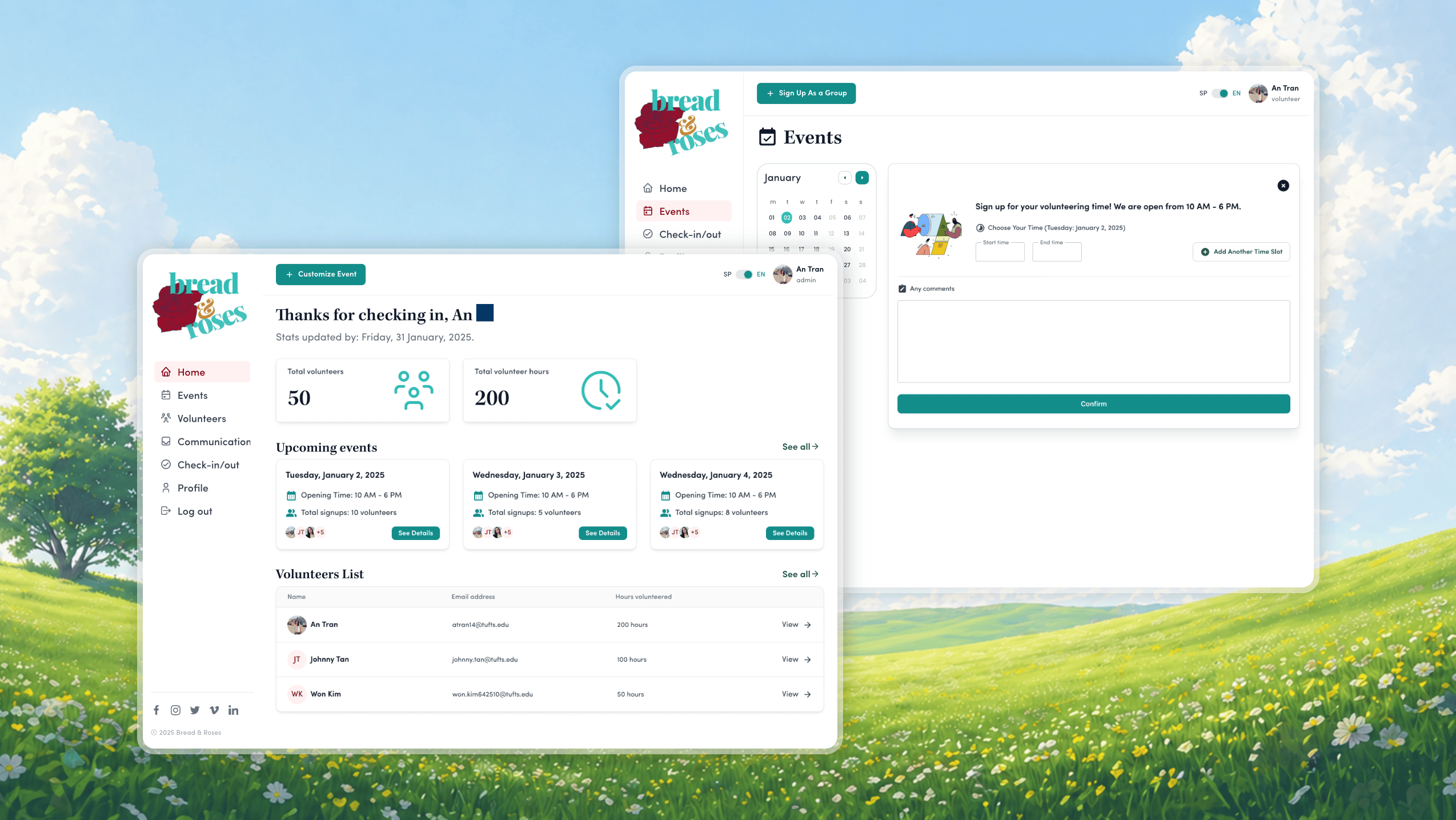
I designed a 0→1 operations platform that helped Bread & Roses coordinate volunteers, attendance, communication, and reporting from a single system. Shipped and launched since 2025.
Problem Statement
As its volunteer network grew, coordinating volunteers relied heavily on spreadsheets, emails, and manual follow-ups, creating a growing administrative burden for staff. Thus, they wants to create a new platform integrated into their existing website to streamline operations for both 7 staff and 50,000 + volunteers.
Problem
Bread & Roses serves over 10,000 households every year, yet volunteer operations still heavily relied on spreadsheets, emails, and manual coordination. As volunteer demand grew, administrative work became the bottleneck and unable to scale accordingly.
Solution
I designed a 0→1 operations platform that helped Bread & Roses coordinate volunteers, attendance, communication, and reporting from a single system. Shipped and launched since 2025.
My Role
As the lead designer, I drove the end-to-end design process from research and problem definition to product strategy, information architecture, and high-fidelity design. Several of my accomplishments include:
Problem
Bread & Roses serves over 10,000 households every year, yet volunteer operations still heavily relied on spreadsheets, emails, and manual coordination. As volunteer demand grew, administrative work became the bottleneck and unable to scale accordingly.
Solution
I designed a 0→1 operations platform that helped Bread & Roses coordinate volunteers, attendance, communication, and reporting from a single system. Shipped and launched since 2025.
👩💻
Design
Own the 0-1 design as a solo designer, advocating for iterative design process
🤝
XFN Work
🤝
XFN Work
Proactively generated ideas with PM, Tech Lead, and the clients, creating agile sprint goals for product roadmap.
👩🏫
Education
👩🏫
Education
Led Figma workshop for new developers, integrating design QA into the process

RESEARCH AND INSIGHTS
I conducted research with 5 Bread & Roses staff members and 40+ volunteers to understand both operational needs and volunteer experiences
The methods and goals of my research are:
Staff interviews (n = 2): Understand current scheduling workflows, business constraints, coordination challenges, and organizational goals.
Volunteer surveys (40+): Identify pain points in the volunteer experience, validate interest in a centralized platform, and understand motivations and barriers to participation.
I conducted research with 5 Bread & Roses staff members and 40+ volunteers to understand both operational needs and volunteer experiences
The methods and goals of my research are:
Staff interviews (n = 2): Understand current scheduling workflows, business constraints, coordination challenges, and organizational goals.
Volunteer surveys (40+): Identify pain points in the volunteer experience, validate interest in a centralized platform, and understand motivations and barriers to participation.

DESIGN STATEMENT
How might we create one platform that reduces staff admin work while giving volunteers more control over their schedules?
How might we create one platform that reduces staff admin work while giving volunteers more control over their schedules?

Mapping Real-Life Workflow From Research
Design Goals
Design Goals
In short, Bread & Roses needs a platform that is both …

Efficient
Efficient
Efficient
Minimizing administrative work through streamlined scheduling and communication workflows

Accessible
Accessible
Accessible
Enabling volunteers to quickly discover, sign up for, and manage shifts independently
FINAL PRODUCTS
A Multi-User System
After multiple rounds of testing with staff and volunteers, the final scheduling platform was delivered and continues to evolve. Feedback informed every iteration - from simplifying volunteer sign-ups to streamlining scheduling workflows. The solution addressed the organization's immediate operational challenges while providing a scalable foundation that can grow alongside its volunteer community.
A Multi-User System
After multiple rounds of testing with staff and volunteers, the final scheduling platform was delivered and continues to evolve. Feedback informed every iteration - from simplifying volunteer sign-ups to streamlining scheduling workflows. The solution addressed the organization's immediate operational challenges while providing a scalable foundation that can grow alongside its volunteer community.

DESIGN CHALLENGE 1
How might we give volunteer autonomy in time slot sign-ups?
Volunteers have limited control over selecting shifts, requiring staff to manually assign schedules and manage back-and-forth coordination. Designing a system that increases volunteer flexibility while reducing staff workload became a key UX challenge.
How might we give volunteer autonomy in time slot sign-ups?
Volunteers have limited control over selecting shifts, requiring staff to manually assign schedules and manage back-and-forth coordination. Designing a system that increases volunteer flexibility while reducing staff workload became a key UX challenge.

DESIGN SOLUTION
Giving volunteers control over their own schedules
Volunteers can browse and reserve available shifts that fit their schedules without contacting staff. By replacing back-and-forth emails and phone calls with self-service scheduling, the system reduces administrative overhead while increasing sign-up flexibility.
Giving volunteers control over their own schedules
Volunteers can browse and reserve available shifts that fit their schedules without contacting staff. By replacing back-and-forth emails and phone calls with self-service scheduling, the system reduces administrative overhead while increasing sign-up flexibility.
Individual Signups
Group Signups
NAVIGATING TRADEOFFS
During ideation, we considered a full Google Calendar-style scheduling system (option 1), since it matched the current system used by the staff.
However, the engineering team raised concerns around development complexity. Therefore, I prioritized a hybrid calendar-card experience that delivered the key user benefit (time-based visibility) (option 2) with significantly lower implementation effort.

Early Explorations
THE PIVOT
However, after early user testing, I found that an event-based selection experience did not match how volunteering actually works
I initially explored event-based scheduling, but user testing revealed that volunteers cared more about reserving recurring time slots than specific event types. After discussing feasibility with engineering, we kept the minimum version of the existing layout while redesigning the sign-up flow around time slots.
However, after early user testing, I found that an event-based selection experience did not match how volunteering actually works
I initially explored event-based scheduling, but user testing revealed that volunteers cared more about reserving recurring time slots than specific event types. After discussing feasibility with engineering, we kept the minimum version of the existing layout while redesigning the sign-up flow around time slots.
DESIGN CHALLENGE 2
How might we create a signup experience that works for both individuals and large groups?
Stakeholder interviews revealed that Bread & Roses served two very different audiences:
Individual volunteers
Corporate groups of up to 100 people
Why separating Individual vs. Group Signups?
Stakeholder interviews revealed that Bread & Roses served two very different audiences:
Individual volunteers
Corporate groups of up to 100 people
Why separating Individual vs. Group Signups?
Stakeholder interviews revealed that Bread & Roses served two very different audiences: individual volunteers and corporate groups of up to 100 people.
At first, a single sign-up form seemed like the simplest solution. However, requiring every group member to register individually created extra work for staff, who had to manually coordinate communications, waivers, and attendance.
Instead of designing one form for everyone, I redesigned the experience around how people actually volunteer. I created separate Individual and Group sign-up flows, making it easier for individuals to sign up, reducing administrative work for staff, and giving the organization better visibility into group participation and corporate partnerships..
🙋
🙋
🙋
Individual volunteers need indepent flexibility
Individual volunteers need indepent flexibility
Individual volunteers need indepent flexibility
✅ Individuals typically sign up for themselves
✅ They want to quickly find a shift that fits their availability
❌ Requiring staff assistance adds unnecessary friction

👫
👫
👫
Groups need coordinated scheduling
Groups need coordinated scheduling
Groups need coordinated scheduling
✅ Corporate and community groups can include up to 100 volunteers
✅ A group organizer often coordinates the signup for everyone
❌ Requiring every member to sign up individually creates additional work

At first, a single sign-up form seemed like the simplest solution. However, requiring every group member to register individually created extra work for staff who had to coordinate communications and attendance as well as group leaders who had to manage their groups.
At first, a single sign-up form seemed like the simplest solution. However, requiring every group member to register individually created extra work for staff who had to coordinate communications and attendance as well as group leaders who had to manage their groups.
DESIGN SOLUTION
I designed two paths that reflect how volunteers actually participate: individual and group sign-ups. This lets individuals self sign up while allowing group leaders to efficiently coordinate their teams
By designing around volunteer behavior, I reduced unnecessary coordination while making signup more flexible for both individuals and groups.
Why separating Individual vs. Group Signups?
Stakeholder interviews revealed that Bread & Roses served two very different audiences: individual volunteers and corporate groups of up to 100 people.
At first, a single sign-up form seemed like the simplest solution. However, requiring every group member to register individually created extra work for staff, who had to manually coordinate communications, waivers, and attendance.
Instead of designing one form for everyone, I redesigned the experience around how people actually volunteer. I created separate Individual and Group sign-up flows, making it easier for individuals to sign up, reducing administrative work for staff, and giving the organization better visibility into group participation and corporate partnerships..
Validating with quick usability testing
Validating with quick usability testing
Validating with quick usability testing
Both signup flows achieved ~90% task success, meeting my initial usability goal.

DESIGN SOLUTION 2
Automated Group Notification
Integrated with the Nodemailer API, administrators can send announcements and updates to hundreds of volunteers in a single action.
The goals of this feature are:
Automated Group Notification
Integrated with the Nodemailer API, administrators can send announcements and updates to hundreds of volunteers in a single action.
The goals of this feature are:
👩🏻💼 For Staff
👩🏻💼 For Staff
👩🏻💼 For Staff
Reduce repetitive administrative work by eliminating manual, individual outreach.
👩🏻🌾 For Volunteers
👩🏻🌾 For Volunteers
👩🏻🌾 For Volunteers
Improve volunteer communication by ensuring timely, consistent updates before upcoming shifts.
DESIGN SOLUTION 3
Scalable Volunteer Database
Volunteer profiles are automatically categorized as individuals or groups during registration, creating a structured database that grows alongside the organization. A centralized system simplifies volunteer management, supports accurate hour tracking, and enables staff to coordinate an expanding volunteer network efficiently.
Scalable Volunteer Database
Volunteer profiles are automatically categorized as individuals or groups during registration, creating a structured database that grows alongside the organization. A centralized system simplifies volunteer management, supports accurate hour tracking, and enables staff to coordinate an expanding volunteer network efficiently.
Large Card
Large Card
Large Card

Compact Card
Compact Card
Compact Card
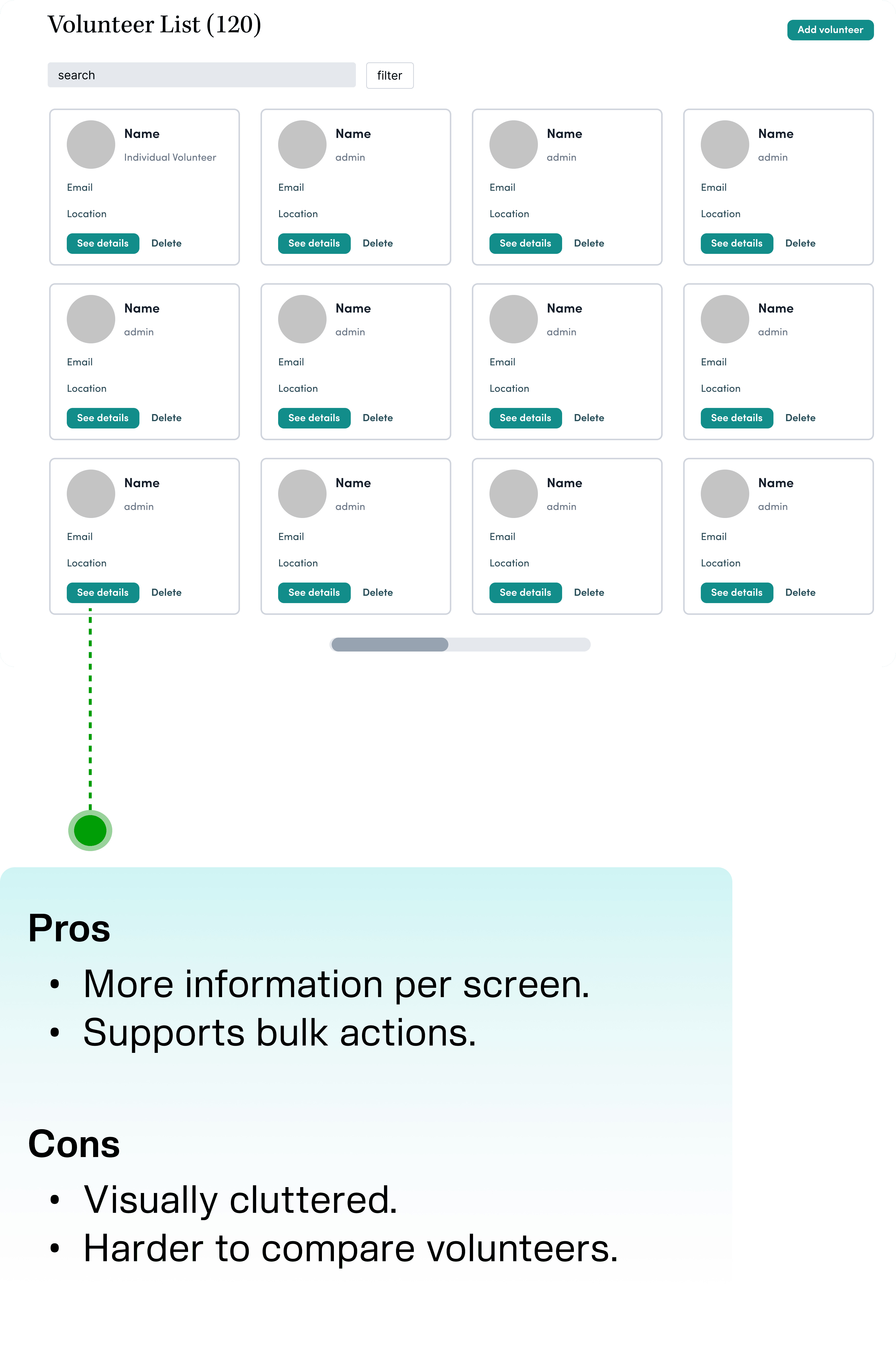
Table View (Chosen)
Table View (Chosen)

THINK IN SYSTEM AND SCALABILITY
Collaboration with the engineering team
As a solo designer, I initiated a new design system based on the current branding. I also designed for edge cases, such as empty states or mobile experience. This process heavily involved the engineers in the loop for feedback as well.
Collaboration with the engineering team
As a solo designer, I initiated a new design system based on the current branding. I also designed for edge cases, such as empty states or mobile experience. This process heavily involved the engineers in the loop for feedback as well.

Design Systems

Edge Cases
PLATFORM LOCALIZATION
Building an inclusive bilingual experience
The nonprofit operates in Lawrence, a city with a large Hispanic and Spanish-speaking population. Thus, through planning with my PM, Tech Lead, and the clients, we agreed to implement a billingual English–Spanish experience to make the platform more inclusive and accessible to the communities they serve.
If I had more time, I would have collaborated more closely with our developer (aka Spanish expert) to understand how translation could affect the layout, visual hierarchy, and overall UX such as differences in text length.
Building an inclusive bilingual experience
The nonprofit operates in Lawrence, a city with a large Hispanic and Spanish-speaking population. Thus, through planning with my PM, Tech Lead, and the clients, we agreed to implement a billingual English–Spanish experience to make the platform more inclusive and accessible to the communities they serve.
If I had more time, I would have collaborated more closely with our developer (aka Spanish expert) to understand how translation could affect the layout, visual hierarchy, and overall UX such as differences in text length.

Draft version (Best engineering effort was made)
FOOD FOR THOUGHT
Reimagining volunteer operations with AI assistant
I envision an AI-driven volunteer assistant that streamlines onboarding, automates shift changes, and resolves routine administrative inquiries, giving staff more time to focus on what matters most: supporting their volunteers and community.
Reimagining volunteer operations with AI assistant
I envision an AI-driven volunteer assistant that streamlines onboarding, automates shift changes, and resolves routine administrative inquiries, giving staff more time to focus on what matters most: supporting their volunteers and community.
Prototype made with Figma Make
KEY LEARNINGS
👨🏻💻 Iterate fast and connect with devs early and often
👨🏻💻 Iterate fast and connect with devs early and often
Working in agile environment means I have to stay highly adaptable and communicative. From the start, I regularly had dev validation discussions with my PM and Tech Lead, which proved incredibly effective in uncovering tech limitations that influenced my design decisions.
🧐 Let user research challenge assumptions
🧐 Let user research challenge assumptions
Initial designs drew from familiar tools like Google Calendar, but user testing revealed these patterns didn’t match volunteers’ real workflows. Pivoting away from these assumptions toward a more flexible approach ensured my solution actually reflected actual operational needs. Sometimes users don't know what they need until we actually have them walk through the solutions.
⚖️ Design for scales, even in small team
Although Bread & Roses is a small nonprofit, they manage a large and growing volunteer base. This pushed me to think about scale early, particularly when designing admin-facing views and data management tools.

Kind words from our clients

Shout out to the squad (we made it on the school news!)
Unifying Fragmented Operations Management for 7 Staff and 50,000+ Volunteers For A Food Donation Nonprofit
Unifying Fragmented Operations Management for 7 Staff and 50,000+ Volunteers For A Food Donation Nonprofit
Unifying Fragmented Operations Management for 7 Staff and 50,000+ Volunteers For A Food Donation Nonprofit
Timeline
5 months
Role
Solo Product Designer
Team
1 Project Manager, 1 Tech Lead, 10 Developers
Skills
Interaction Design, Visual Design, UX Research, Systems Thinking, Design Systems
Timeline
5 months
Skills
Interaction Design, Visual Design, UX Research, Systems Thinking, Design Systems
Timeline
5 months
Role
Solo Product Designer
Team
1 Project Manager, 1 Tech Lead, 10 Developers
Role
Solo Product Designer
Team
1 Project Manager, 1 Tech Lead, 10 Developers
LONG STORY SHORT
Who is Bread & Roses?
Bread & Roses is a nonprofit organization donating meals to over 10,000 households each year.
This project was a contract through JumboCode, a Tufts student-run digital agency that builds software solutions for nonprofits.
Bread & Roses is a nonprofit organization donating meals to over 10,000 households each year.
This project was a contract through JumboCode, a Tufts student-run digital agency that builds software solutions for nonprofits.
Problem Statement
Volunteer coordination was growing, but the process remained manual. The problem wasn’t a lack of volunteers, but the difficulty of managing them efficiently.
Relying on spreadsheets, emails, and manual follow-ups created a growing burden for just 7 staff members managing 50,000+ volunteers. The organization needed a platform to simplify coordination and streamline operations.
Problem Statement
As its volunteer network grew, coordinating volunteers relied heavily on spreadsheets, emails, and manual follow-ups, creating a growing administrative burden for staff. Thus, they wants to create a new platform integrated into their existing website to streamline operations for both 7 staff and 50,000 + volunteers.
My Role
As the lead designer, I drove the end-to-end design process from research and problem definition to product strategy, information architecture, and high-fidelity design. Several of my accomplishments include:
👩💻
Design
Own the 0-1 design as a solo designer, advocating for iterative design process
🤝
XFN Work
Proactively generated ideas with PM, Tech Lead, and the clients, creating agile sprint goals for product roadmap.
👩🏫
Education
Led Figma workshop for new developers, integrating design QA into the process
My Role
As the lead designer, I drove the end-to-end design process from research and problem definition to product strategy, information architecture, and high-fidelity design. Several of my accomplishments include:
👩💻
Design
Owned the 0-1 design as a solo designer, advocating for iterative design process
🤝
XFN Work
Proactively generated ideas with PM, Tech Lead, and the clients, creating agile sprint goals for product roadmap
👩🏫
Education
Led Figma workshop for new developers, integrating design QA into the process
BUSINESS IMPACTS
Since launched, the design had helped the organization …
+25%
+25%
+25%
Increase in volunteer application
Increase in volunteer application
Increase in volunteer application
-40%
-40%
-40%
Reduction in manual scheduling time
Reduction in manual scheduling time
Reduction in manual scheduling time
~$50K
~$50K
~$50K
Recovery in Productivity
(~1 hr/day saved per staff)
Recovery in Productivity
(~1 hr/day saved per staff)
Recovery in Productivity
(~1 hr/day saved per staff)
LONG STORY SHORT
Bread & Roses is a nonprofit organization donating meals to over 10,000 households each year.
This project was a contract through JumboCode, a Tufts student-run digital agency that builds software solutions for nonprofits.
Problem
Bread & Roses serves over 10,000 households every year, yet volunteer operations still heavily relied on spreadsheets, emails, and manual coordination. As volunteer demand grew, administrative work became the bottleneck and unable to scale accordingly.
Solution
I designed a 0→1 operations platform that helped Bread & Roses coordinate volunteers, attendance, communication, and reporting from a single system. Shipped and launched since 2025.
Problem Statement
As its volunteer network grew, coordinating volunteers relied heavily on spreadsheets, emails, and manual follow-ups, creating a growing administrative burden for staff. Thus, they wants to create a new platform integrated into their existing website to streamline operations for both 7 staff and 50,000 + volunteers.
Problem
Bread & Roses serves over 10,000 households every year, yet volunteer operations still heavily relied on spreadsheets, emails, and manual coordination. As volunteer demand grew, administrative work became the bottleneck and unable to scale accordingly.
Solution
I designed a 0→1 operations platform that helped Bread & Roses coordinate volunteers, attendance, communication, and reporting from a single system. Shipped and launched since 2025.
My Role
As the lead designer, I drove the end-to-end design process from research and problem definition to product strategy, information architecture, and high-fidelity design. Several of my accomplishments include:
Problem
Bread & Roses serves over 10,000 households every year, yet volunteer operations still heavily relied on spreadsheets, emails, and manual coordination. As volunteer demand grew, administrative work became the bottleneck and unable to scale accordingly.
Solution
I designed a 0→1 operations platform that helped Bread & Roses coordinate volunteers, attendance, communication, and reporting from a single system. Shipped and launched since 2025.
👩💻
Design
Own the 0-1 design as a solo designer, advocating for iterative design process
🤝
XFN Work
🤝
XFN Work
Proactively generated ideas with PM, Tech Lead, and the clients, creating agile sprint goals for product roadmap.
👩🏫
Education
👩🏫
Education
Led Figma workshop for new developers, integrating design QA into the process
RESEARCH AND INSIGHTS
I conducted research with 5 Bread & Roses staff members and 40+ volunteers to understand both operational needs and volunteer experiences
The methods and goals of my research are:
Staff interviews (n = 2): Understand current scheduling workflows, business constraints, coordination challenges, and organizational goals.
Volunteer surveys (40+): Identify pain points in the volunteer experience, validate interest in a centralized platform, and understand motivations and barriers to participation.
I conducted research with 5 Bread & Roses staff members and 40+ volunteers to understand both operational needs and volunteer experiences
The methods and goals of my research are:
Staff interviews (n = 2): Understand current scheduling workflows, business constraints, coordination challenges, and organizational goals.
Volunteer surveys (40+): Identify pain points in the volunteer experience, validate interest in a centralized platform, and understand motivations and barriers to participation.
DESIGN STATEMENT
How might we create one platform that reduces staff admin work while giving volunteers more control over their schedules?
How might we create one platform that reduces staff admin work while giving volunteers more control over their schedules?
Mapping Real-Life Workflow From Research
Design Goals
Design Goals
In short, Bread & Roses needs a platform that is both …
Efficient
Efficient
Efficient
Minimizing administrative work through streamlined scheduling and communication workflows
Accessible
Accessible
Accessible
Enabling volunteers to quickly discover, sign up for, and manage shifts independently
FINAL PRODUCTS
A Multi-User System
After multiple rounds of testing with staff and volunteers, the final scheduling platform was delivered and continues to evolve. Feedback informed every iteration - from simplifying volunteer sign-ups to streamlining scheduling workflows. The solution addressed the organization's immediate operational challenges while providing a scalable foundation that can grow alongside its volunteer community.
A Multi-User System
After multiple rounds of testing with staff and volunteers, the final scheduling platform was delivered and continues to evolve. Feedback informed every iteration - from simplifying volunteer sign-ups to streamlining scheduling workflows. The solution addressed the organization's immediate operational challenges while providing a scalable foundation that can grow alongside its volunteer community.
DESIGN CHALLENGE 1
How might we give volunteer autonomy in time slot sign-ups?
Volunteers have limited control over selecting shifts, requiring staff to manually assign schedules and manage back-and-forth coordination. Designing a system that increases volunteer flexibility while reducing staff workload became a key UX challenge.
How might we give volunteer autonomy in time slot sign-ups?
Volunteers have limited control over selecting shifts, requiring staff to manually assign schedules and manage back-and-forth coordination. Designing a system that increases volunteer flexibility while reducing staff workload became a key UX challenge.
DESIGN SOLUTION
Giving volunteers control over their own schedules
Volunteers can browse and reserve available shifts that fit their schedules without contacting staff. By replacing back-and-forth emails and phone calls with self-service scheduling, the system reduces administrative overhead while increasing sign-up flexibility.
Giving volunteers control over their own schedules
Volunteers can browse and reserve available shifts that fit their schedules without contacting staff. By replacing back-and-forth emails and phone calls with self-service scheduling, the system reduces administrative overhead while increasing sign-up flexibility.
Individual Signups
Group Signups
NAVIGATING TRADEOFFS
During ideation, we considered a full Google Calendar-style scheduling system (option 1), since it matched the current system used by the staff.
However, the engineering team raised concerns around development complexity. Therefore, I prioritized a hybrid calendar-card experience that delivered the key user benefit (time-based visibility) (option 2) with significantly lower implementation effort.
Early Explorations
THE PIVOT
However, after early user testing, I found that an event-based selection experience did not match how volunteering actually works
I initially explored event-based scheduling, but user testing revealed that volunteers cared more about reserving recurring time slots than specific event types. After discussing feasibility with engineering, we kept the minimum version of the existing layout while redesigning the sign-up flow around time slots.
However, after early user testing, I found that an event-based selection experience did not match how volunteering actually works
I initially explored event-based scheduling, but user testing revealed that volunteers cared more about reserving recurring time slots than specific event types. After discussing feasibility with engineering, we kept the minimum version of the existing layout while redesigning the sign-up flow around time slots.
DESIGN CHALLENGE 2
How might we create a signup experience that works for both individuals and large groups?
Stakeholder interviews revealed that Bread & Roses served two very different audiences:
Individual volunteers
Corporate groups of up to 100 people
Why separating Individual vs. Group Signups?
Stakeholder interviews revealed that Bread & Roses served two very different audiences:
Individual volunteers
Corporate groups of up to 100 people
Why separating Individual vs. Group Signups?
Stakeholder interviews revealed that Bread & Roses served two very different audiences: individual volunteers and corporate groups of up to 100 people.
At first, a single sign-up form seemed like the simplest solution. However, requiring every group member to register individually created extra work for staff, who had to manually coordinate communications, waivers, and attendance.
Instead of designing one form for everyone, I redesigned the experience around how people actually volunteer. I created separate Individual and Group sign-up flows, making it easier for individuals to sign up, reducing administrative work for staff, and giving the organization better visibility into group participation and corporate partnerships..
🙋
🙋
🙋
Individual volunteers need indepent flexibility
Individual volunteers need indepent flexibility
Individual volunteers need indepent flexibility
✅ Individuals typically sign up for themselves
✅ They want to quickly find a shift that fits their availability
❌ Requiring staff assistance adds unnecessary friction
👫
👫
👫
Groups need coordinated scheduling
Groups need coordinated scheduling
Groups need coordinated scheduling
✅ Corporate and community groups can include up to 100 volunteers
✅ A group organizer often coordinates the signup for everyone
❌ Requiring every member to sign up individually creates additional work
At first, a single sign-up form seemed like the simplest solution. However, requiring every group member to register individually created extra work for staff who had to coordinate communications and attendance as well as group leaders who had to manage their groups.
At first, a single sign-up form seemed like the simplest solution. However, requiring every group member to register individually created extra work for staff who had to coordinate communications and attendance as well as group leaders who had to manage their groups.
DESIGN SOLUTION
I designed two paths that reflect how volunteers actually participate: individual and group sign-ups. This lets individuals self sign up while allowing group leaders to efficiently coordinate their teams
By designing around volunteer behavior, I reduced unnecessary coordination while making signup more flexible for both individuals and groups.
Why separating Individual vs. Group Signups?
Stakeholder interviews revealed that Bread & Roses served two very different audiences: individual volunteers and corporate groups of up to 100 people.
At first, a single sign-up form seemed like the simplest solution. However, requiring every group member to register individually created extra work for staff, who had to manually coordinate communications, waivers, and attendance.
Instead of designing one form for everyone, I redesigned the experience around how people actually volunteer. I created separate Individual and Group sign-up flows, making it easier for individuals to sign up, reducing administrative work for staff, and giving the organization better visibility into group participation and corporate partnerships..
Validating with quick usability testing
Validating with quick usability testing
Validating with quick usability testing
Both signup flows achieved ~90% task success, meeting my initial usability goal.
DESIGN SOLUTION 2
Automated Group Notification
Integrated with the Nodemailer API, administrators can send announcements and updates to hundreds of volunteers in a single action.
The goals of this feature are:
Automated Group Notification
Integrated with the Nodemailer API, administrators can send announcements and updates to hundreds of volunteers in a single action.
The goals of this feature are:
👩🏻💼 For Staff
👩🏻💼 For Staff
👩🏻💼 For Staff
Reduce repetitive administrative work by eliminating manual, individual outreach.
👩🏻🌾 For Volunteers
👩🏻🌾 For Volunteers
👩🏻🌾 For Volunteers
Improve volunteer communication by ensuring timely, consistent updates before upcoming shifts.
DESIGN SOLUTION 3
Scalable Volunteer Database
Volunteer profiles are automatically categorized as individuals or groups during registration, creating a structured database that grows alongside the organization. A centralized system simplifies volunteer management, supports accurate hour tracking, and enables staff to coordinate an expanding volunteer network efficiently.
Scalable Volunteer Database
Volunteer profiles are automatically categorized as individuals or groups during registration, creating a structured database that grows alongside the organization. A centralized system simplifies volunteer management, supports accurate hour tracking, and enables staff to coordinate an expanding volunteer network efficiently.
Large Card
Large Card
Large Card
Compact Card
Compact Card
Compact Card
Table View (Chosen)
Table View (Chosen)
THINK IN SYSTEM AND SCALABILITY
Collaboration with the engineering team
As a solo designer, I initiated a new design system based on the current branding. I also designed for edge cases, such as empty states or mobile experience. This process heavily involved the engineers in the loop for feedback as well.
Collaboration with the engineering team
As a solo designer, I initiated a new design system based on the current branding. I also designed for edge cases, such as empty states or mobile experience. This process heavily involved the engineers in the loop for feedback as well.
Design Systems
Edge Cases
PLATFORM LOCALIZATION
Building an inclusive bilingual experience
The nonprofit operates in Lawrence, a city with a large Hispanic and Spanish-speaking population. Thus, through planning with my PM, Tech Lead, and the clients, we agreed to implement a billingual English–Spanish experience to make the platform more inclusive and accessible to the communities they serve.
If I had more time, I would have collaborated more closely with our developer (aka Spanish expert) to understand how translation could affect the layout, visual hierarchy, and overall UX such as differences in text length.
Building an inclusive bilingual experience
The nonprofit operates in Lawrence, a city with a large Hispanic and Spanish-speaking population. Thus, through planning with my PM, Tech Lead, and the clients, we agreed to implement a billingual English–Spanish experience to make the platform more inclusive and accessible to the communities they serve.
If I had more time, I would have collaborated more closely with our developer (aka Spanish expert) to understand how translation could affect the layout, visual hierarchy, and overall UX such as differences in text length.
Draft version (Best engineering effort was made)
FOOD FOR THOUGHT
Reimagining volunteer operations with AI assistant
I envision an AI-driven volunteer assistant that streamlines onboarding, automates shift changes, and resolves routine administrative inquiries, giving staff more time to focus on what matters most: supporting their volunteers and community.
Reimagining volunteer operations with AI assistant
I envision an AI-driven volunteer assistant that streamlines onboarding, automates shift changes, and resolves routine administrative inquiries, giving staff more time to focus on what matters most: supporting their volunteers and community.
Prototype made with Figma Make
KEY LEARNINGS
👨🏻💻 Iterate fast and connect with devs early and often
👨🏻💻 Iterate fast and connect with devs early and often
Working in agile environment means I have to stay highly adaptable and communicative. From the start, I regularly had dev validation discussions with my PM and Tech Lead, which proved incredibly effective in uncovering tech limitations that influenced my design decisions.
🧐 Let user research challenge assumptions
🧐 Let user research challenge assumptions
Initial designs drew from familiar tools like Google Calendar, but user testing revealed these patterns didn’t match volunteers’ real workflows. Pivoting away from these assumptions toward a more flexible approach ensured my solution actually reflected actual operational needs. Sometimes users don't know what they need until we actually have them walk through the solutions.
⚖️ Design for scales, even in small team
Although Bread & Roses is a small nonprofit, they manage a large and growing volunteer base. This pushed me to think about scale early, particularly when designing admin-facing views and data management tools.
Kind words from our clients
Shout out to the squad (we made it on the school news!)